• twenty-sixth and final letter of the Latin alphabet, twenty-first consonant
  • phonetic name: "voiced alveolar fricative"; press the tip of your tongue against your alveolar ridge and vibrate your tongue with your vocal chords while letting sound pass through your lips (n.b.: Z sound engages the vocal cords, S sound does not)
  • Egyptian hieroglyph was a lock or bolt
  • Phoenician letter was zayin
  • Z looked more like a capital I until it was adopted by Greeks as zeta, and the central stem was italicized (uppercase Ζ, lowercase ζ)
  • Roman censor Appius Claudius Caecus hated Z "because it resembles, in its expression, the teeth of a corpse… a death grin"
  • Z is regarded as superfluous in Shakespeare's King Lear: "Thou whoreson zed! Thou unnecessary letter!" (II.ii.)
  • Z is pronounced zed in Canada, zee in the USA, and was once pronounced izzard in the UK
  • many Canadian words substitute Z for S (i.e.: organize vs. organise)
  • the sound of Z (usually marked zzz…) evokes mechanical humming, insects flying, or sleeping/snoring
  • uppercase and lowercase characters have identical shape; diagonal line creates dynamic energy
  • Z is the most rarely used letter, making it seem exotic or special when employed. Also common in wacky words (bizarre, crazy, zany, etc.)
  • associated with lightning, slithering, firearms
  • as lightning it unites earth and sky
  • the word zigzag (origin unknown) describes the shape of Z and used two Zs (n.b.: Traditionally a "zig" points in the left direction [/]and a "zag" points right [\])
  • its sharpness invokes strength, force and vigour
  • Z also suggest speed (as in zip, zap and zoom!)
  • Z is the last letter of the alphabet, but is the first letter of the word zero, the first number
  • As the last letter of the alphabet, Z implies finality, but is also a sign of life and beginnings; the word zoo is derived from the Greek root for "living being" or "animal", and the name Zoë comes from the Greek word for "life"
  • in fortune telling, Z is a sign of bad luck (lightning, death)
  • in math, ℤ with a bolded or double stem is the symbol for a set of all integers
  • in graphs, the Z axis creates the third dimension of depth (in conjunction with X and Y)
  • in road signs, Z shape warns of skidding or sliding danger ahead
  • in electronics, Z is impedance
  • in currency, Z is the Zairean zaire
  • Z can stand for Zorro, fictional hero created by Johnston McCulley; the Z is to mark Zorro's speed and precision (Zorro means "fox" in Spanish)
  • Z can also abbreviate the unknown, atomic number, Zambia, zero and zone
  • Z can represent many Z shapes objects: Z bar, Z beam, Z twist
  • Z is sometimes used to draw attention to a pluralization, sometimes making reference to African American slang (i.e. boyz, girlz, etc.)
  • NATO phonetic alphabet: ZULU
  • "The sound vibration of the consonant 'W' means 'as above, so below, heaven and earth'." - Joseph E. Rael
  • "'Z' is lightning, the sign of God." - Victor Hugo

  • twenty-fifth letter of the Latin alphabet, twentieth consonant OR sixth vowel (considered a semivowel)
  • phonetic name: "palatal approximant"; press your tongue to your palate and slowly release with a voice
  • Egyptian hieroglyph was two sprouted reeds
  • Phoencian letter was waw (just like F)
  • adopted by Greeks as upsilon (uppercase Υ, lowercase υ)
  • Y and U were often used interchangeably in Rome; it also had a numeric value of 150
  • in Middle English, Y began replacing vowel I; also, Y sometimes stood in for "th" (i.e.: "the" became "eye" or "ye', as in "Ye Olde English Pub")
  • uppercase Y often looks like a small V placed on a small I
  • Y becomes IE at the end of a word becoming pluralized
  • the letter 'y' in spanish means "and"
  • associated with femininity, Pythagoras, receptiveness
  • the shape of Y is closely tied to that of a tree (in particular, the Tree of Samos, or Pythagoras' letter); Pythagoras used Y as a symbol of the divergent paths of virtue and vice
  • Y shape was popular in Renaissance writing and art because of its association with life's directions and choices
  • like V, Y recalls female genitalia, with an added stem that could represent the opposite sex. This is sometimes associated with balanced loving relationships, or, androgyny
  • Y also radiates a sense of happiness or rejoice as a human form with its arms raised in the air
  • in biology, men have XY sex chromosomes (women have XX)
  • in algebra, Y stands for an unknown variable, secondary to X
  • in graphs, the Y axis runs vertically
  • in printing, Y stands for yellow (CMYK)
  • in electricity, Y stands for admittance
  • Y with two horizontal strokes, ¥, is the currency sign for the Japanese yen
  • Y in a circle, Ⓨ, is a symbol for Japanese resale price maintenance
  • Y is a type of silver moth, as well as a type of gapeworm
  • Y can abbreviate the pronoun "you"
  • Y can abbreviate the affirmative "yes"
  • Y can also abbreviate year
  • Y sometimes refers to the YMCA
  • Y can represent many things that separate or connect: railroads, highways, guns, telescopes, ligaments, gutters, tubes
  • Y is the amino acid tyrosine
  • Y is the chemical symbol for yttrium (#39 on the periodic table), a silvery-metallic element found in most rare-earth minerals. It is used as a "phosphor" to produce the red colour in television screens.
  • Generation Y (also known as the Millennium Generation or Millennials) refers to the group of people born between 1980 and 2000. Generally, they have an increased use and familiarity with communications, media, and technology, and a neo-liberal approach to politics and economics.
  • phonetic sound, "why", asks for a reason
  • NATO phonetic alphabet: YANKEE
  • "The sound vibration of the consonant 'Y' means 'awareness'." - Joseph E. Rael
  • "'Y' is a tree, a fork, the confluence of two rivers, a stemmed glass, a man with arms upstretched." - Victor Hugo

  • twenty-fourth letter of the Latin alphabet, nineteenth consonant
  • phonetic name: "voiceless velar fricative"; place the back of your tongue against your velum release a pop of air while whistling some air between your teeth (n.b.: the sound is the combination of K and S; pronounced "kiss" without the letter i)
  • Phonecian was samekh, a fishbone or tree with branches (Hebrew word means "to prop" or "to support")
  • Egyptian hieroglyph was a small quail
  • adopted by Greeks as xi, pronounced chi (uppercase Ξ, lowercase ξ)
  • Romans often used X and S interchangeably; X is also the Roman numeral for 10
  • X is the least used letter at the beginning of English words; most words that start with X are derived from Ancient Greece (i.e.: xenon means foreign thing, which also correlates with Xs mysterious reputation)
  • X is the most printed one letter symbol
  • has various pronunciations (box, luxury, exact, xylophone, x-ray)
  • in type design, the two stems are often slightly above true centre ("optical centre"); sometimes, the top strokes do not connect perfectly with the bottom strokes
  • generally, X has the same form in both upper and lower case
  • associated with structure, crossing and danger
  • often bridges opposing ideas; can symbolize both life / death, physical / spiritual, break / protect (n.b.: can mean both yes and no)
  • X also oscillates between radiance (moving outward) and a vortex (moving inwards towards a focal point)
  • Latin word for peace, pax, is often symbolized with a monogram of P and X
  • X is consider solid and stable, with its 2 diagonal crossbeams - likened to a stool, chair or bench
  • in mathematics, X stands for multiplication (can also refer to magnification; 10x = 10 times the size)
  • in algebra, X stands for an unknown variable
  • in graphs, the X axis runs horizontally
  • in film, X rated is usually pornographic (XXX)
  • in sizes, X indicates extra (as in XL, XL, XXL)
  • in branding and trademarks, X is often used to attract attention (Xbox, X-Files, QuarkXPress)
  • in biology, women have XX and men have XY sex chromosomes
  • in beer brewing, Xs are used to indicate strength (X= weakest, XXX=strongest)
  • on road signs, X indicates a crossing and a risk of danger
  • on maps, X marks a point, destination or buried treasure (x mark the spot!)
  • on exams, X indicates an incorrect answer
  • in bowling, X is a strike
  • X is used as a visual device to block, cancel or annul
  • X abbreviates Christ in Xmas
  • X-rays are a form of electromagnetic radiation with a weak wavelength which can pass through matter
  • X-men are mutant superheroes
  • the X shape of a skull and crossbones can represent pirates, or poison
  • there is a superstition that crossing flatware at a table setting is bad luck
  • in elections, X is the valid mark used to indicate your vote on a ballot
  • X's are the basis for cross-stitching
  • X is the legal signature for an illiterate. In the Middle Ages, an illiterate person would sign an X and kiss it as a sign of promise/agreement. Xs became associated with kisses, hence the use of xoxoxo
  • X is slang for the hallucinogenic drug ecstacy
  • Generation X is loosely associated with the first generation of people born after the baby boom (1960-1980)
  • Malcolm X was an African American human rights activist; on his name: "The Muslim's 'X' symbolized the true African family name that he never could know. For me, my 'X' replaced the white slavemaster name of 'Little' which some blue-eyed devil named Little had imposed upon my paternal forebears."
  • Xe is the chemical symbol for xenon (#54 on the periodic table), an odourless, colourless, inert gas which, in a vacuum tube, produces a blue glow when excited by an electrical charge.
  • phonetic sound, ex, can refer to previous lovers/spouses (ex, exes)
  • NATO phonetic alphabet: X-RAY
  • "The sound vibration of the consonant 'X' means 'power, empowered'." - Joseph E. Rael
  • "'X' is crossed swords, a battle; who will win we do not know, so the philosophers made it the sign of destiny and the mathematicians the sign of the unknown." - Victor Hugo
The letter X,
for explicit sex,
for the ghastly formula,
the buried treasure,
the missing number,
the undisclosed measure,
the crossroads,
the crossed heart,
the cross,
the illiterate signature,
the inferior brand name,
the typing over mistakes,
the inebriate’s eyeball
or the fish-market fish’s,
the incorrect answer,
the life-saving stitch,
the whirlybird,
the anonymous grave,
the secret plan,
the forbidden planet,
the unknown man,
the number ten,
multiplication,
shorthand for Christ
and all that’s hidden,
the target the bomb misses,
the poison bottle,
the liquor keg,
the divorced, the former, the past,
and at the last,
at the end of the letter,
written, perhaps unbidden
kisses.

-Mark O’Donnell

  • twenty-third letter of the Latin alphabet, eighteenth consonant
  • phonetic name: "voiced bilabial semivowel"; pucker your lips into a circle and make a sound from your vocal chords as your release the tension in your lips (n.b.: W is one of the few letters whose name does not match its sound AND the only letter name with more than one syllable)
  • Egyptian hieroglyph was a small quail
  • W only appears around the twelfth century, first as UU, the UV, and then later as VV
  • W was reluctantly accepted in the French alphabet in the late 18th century; "We may say that this letter belongs in no way to the French alphabet; for although it may be pronounced sometimes as [v] and sometimes as [w], it hardly attains the genius of our language." -1839 French dictionary
  • French printers later began to prefer the double V shape
  • the english W ("double-u") evokes the earlier handwritten form; the French W (which translates literally as "double-v") refers more to the print shape
  • W is represented as either two linked (an upside down M) or overlapping Vs
  • W is usually the Widest letter in standard typefaces
  • W can be silent (two, answer)
  • W is a vowel in Welsh language
  • W in the Finnish alphabet is still seen as a variant of V and not a separate letter
  • In Arabic, W is written using the penultimate letter of the alphabet, waw
  • associated with water and duplication
  • the shape of W is closely tied to pictograms of water (n.b.: it is also the first letter of the words "water" and "wet")
  • W on a map, compass or weather map is West
  • W wants to know all the answers: who, what, when, where, and why?
  • in electricity, W stands for watt, a unit of mechanical or electrical power
  • in radio, W band ranges from 75 to 111 GHz
  • in physics, W is the symbol for mechanical work
  • W is also associate with George W. (Dubya) Bush, 43rd President of the United States
  • W is an American women's fashion magazine
  • W is the amino acid associated with turkey meat and drowsiness (which is a myth)
  • W can also abbreviate Wales, warden, Wednesday, weekly, weight, western, wide, width, widow, wife, with, work
  • double W (WW) abbreviates World War (WWI, WWII)
  • triple W (WWW) stands for world wide web
  • W is the chemical symbol for tungsten (#74 on the periodic table), a gray metal that has the highest melting point and lowest vapour pressure of all metals, and also has excellent corrosion resistance properties.
  • NATO phonetic alphabet: WHISKEY
  • "The sound vibration of the consonant 'W' means 'two ways of descending light'." - Joseph E. Rael

  • twenty-second letter of the Latin alphabet, seventeenth consonant
  • phonetic name: "voiced labiodental fricative"; place your top teeth on your bottom lip, vocalize and release (n.b. V engages the vocal chord, F does not)
  • like U, Egyptian hieroglyphs was a snake/dragon (Cerastes)
  • like U, Proto-Sinaitic letter for U, V & W was waw, all derived from the letter F
  • like U, Greeks adopted it as their letter upsilon (uppercase Υ, lowercase υ), pronounced yoo-psil-on, and meaning "naked U"
  • in Roman, 'V' represents 5; on monuments, U was often an abbreviation of urbs (city), usus (used/usage) or uxor (woman)
  • 'V' as 5 is derived from the convention of counting by notches carved in wood, with every fifth notch cut to form a V shape
  • Julius Caesar is known for his post-battle message "Veni, vidi, vici" ("I came, I saw, I conquered")
  • U and V were indistinguishable until the 18th century, when V officially became a consonant
  • V is not used very frequently in English, but appears frequently in the Spanish language (where it is pronounced as B)
  • associated with purpose, immersion, advancement
  • V is dynamic and positive; conveying spreading of arms, wings, expressing vitality, joy and freedom (found in positive words like vivacious, vivid)
  • V's sound is soft, caressing and sensual, but also fast and trembling (like the wind)
  • V (like U) evokes the idea of a container by its form, and is also shown in words like vase, vessel, vial, vat, ventricle
  • V has always been associated with the feminine (vagina, vulva) and V recalls the Sumerian ideogram for "woman" (a triangle on point)
  • V is the first letter of the goddess of love and beauty (Venus), and central to the name Eve
  • clock and watch hands are often set at 10:10 (making a V shape), which is considered positive (like a check mark)
  • in WWII, V was a symbol for Victory for the allies; V can be formed with the index and middle finger, meaning "peace" (attributed to Winston Churchill)
  • V can be formed by two arms in the air, indicating that help is needed
  • in music, V indicates passages to be played by violin, or volti (turn); VS means volti subito (turn quickly)
  • in geometry, V stands for volume
  • in electricity, V is voltage or volt, electric potential difference in a circuit, or its unit of measurement
  • in grammar, V is verb
  • in radio, V band ranges from 50 to 75 GHz
  • v. or vs. abbreviated "versus"
  • geese are known to fly in a V-shape when migrating, and is considered to be aerodynamically efficient; V formations are also used on military flight missions
  • the V8 car engine originated in the 1915 Cadillac, with its two rows of four cylinders
  • V8 is a canned beverage containing 8 vegetables: tomatoes, beets, celery, carrots, lettuce, parsley, watercress, and spinach
  • V (like T and U) is often used to describe the shape of objects: V-block, V-bottom, V-cut, V hut, V-neck, V-antenna, V-beam, V belt, V bob, V roof, V-hook, V moth, V notch, V particle, V-type engine, V-pug, V stern, V tail, V thread, V tool, V vat, V chip etc.
  • V is the chemical symbol for vanadium (#92 on the periodic table), a greyish silvery metal, and is most often used as an additive to improve steels
  • NATO phonetic alphabet: VICTOR
  • "'V' is the vase." -Victor Hugo, French poet & playwright
  • "The sound vibration of the consonant 'V' means 'descending light'." - Joseph E. Rael
  • "Voilà! In view, a humble vaudevillian veteran, cast vicariously as both victim and villain by the vicissitudes of Fate. This visage, no mere veneer of vanity, is a vestige of the vox populi, now vacant, vanished. However, this valorous visitation of a by-gone vexation, stands vivified and has vowed to vanquish these venal and virulent vermin van-guarding vice and vouchsafing the violently vicious and voracious violation of volition. The only verdict is vengeance; a vendetta, held as a votive, not in vain, for the value and veracity of such shall one day vindicate the vigilant and the virtuous. Verily, this vichyssoise of verbiage veers most verbose, so let me simply add that it's my very good honor to meet you and you may call me V." - from V for Vendetta, film based on the dystopian comic book series by Alan Moore
  • V can also abbreviate Vatican City, verb, verse, version, verso, very, victory, volume, voice

  • twenty-first letter of the Latin alphabet, fifth and final vowel
  • phonetic name: "near-close near-back vowel" or "close central rounded vowel; sound: press your tongue to your palate and vocalize while closing your lips
  • Egyptian hieroglyphs was a snake/dragon (Cerastes)
  • Proto-Sinaitic letter for U, V & W was waw, all derived from the letter F
  • Greeks adopted it as their letter upsilon (uppercase Υ, lowercase υ), pronounced yoo-psil-on, and meaning "naked U"
  • in Roman, 'U' (written V) represents 5; on monuments, U was often an abbreviation of urbs (city), usus (used/usage) or uxor (woman)
  • U and V were indistinguishable for centuries; in the ninth century, we see U sometimes topped with a small accent / diacritic mark
  • the first time the letters U and V were consistently differentiated was in 1386; in 1548, U was first used as a vowel (with a rounded base) and V as a consonant (with a pointed base), but this was not officially recognized by the French Academy until 1726
  • W, aka "double-U", was originally called "double vay" / "double-V" (which actually makes more sense) :P
  • upper case U came into being in 1629
  • U is the only vowel that doesn't have a consistent matching long vowel sound (vs. ay, ee, igh, oh); long U can also be pronounced "oo" (ie. blue, rude)
  • short U can be shallow (ie. cup, sun, butter) or deep (ie. push, pull)
  • U is very common in vowel pairings, which produces a huge variety of sounds (au, ua, eu, ue, iu, ui, ou, uo and uu)
  • U almost always follows Q (exceptions here), and very often after G
  • associated with receptacle, earth, femininity
  • U evokes a cup or container designed to receive, hold or contain; often related to the female uterus (n.b.: U also appears twice in the word uterus)
  • U also suggests a horseshoe or magnet - strong, potent, made or iron
  • U is associated with the colour green, flora and chlorophyll, and sometimes connected to wood, the rustic and traditional values
  • when sung on musical note C, U acts on the first chakra (aka "the root chakra"), which is associated with the colour red, squares, and the universe
  • U is often used to describe the shape of objects: U-lock, U-turn, U-bolt, U-rail, U-tube
  • U-boat is a military submarine from the German Unterseeboot, meaning "undersea boat"
  • U inside a circle, Ⓤ, indicates kosher, which means "suitable for consumption" in Hebrew
  • U in education can mean Unsatisfactory
  • U abbreviates University (U of T = University of Toronto) and United (USA, UAE, etc.)
  • UV abbreviates ultra-violet
  • phonetic sound, "yoo", is the second-person personal pronoun (you!), or a female domestic sheep (ewe)
  • yu (竽; pronounced yoo) is also a free reed wind instrument imported from ancient China
  • U very often abbreviates the word "you", especially in text messaging, email, and SMS language
  • rockband U2 chose their name partly in reference to an Irish federal unemployment insurance form called a U-2
  • U is the chemical symbol for uranium (#92 on the periodic table), a silvery-white metal that is the only naturally occurring fissile isotope. Its radioactive properties make it practical for medical x-rays, nuclear power and nuclear weapons.
  • NATO phonetic alphabet: UNIFORM
  • "From a lump of clay we fashion a vase; This empty space in the vase permits its use." - Lao Tsu
  • "U, waves, divine vibrations of verdant seas, Peace of pastures dotted with livestock, peace of the furrows, Which alchemy prints on broad studious brows." - Arthur Rimbaud, Vowels
  • "'U' is the urn." -Victor Hugo, French poet & playwright
  • "The sound vibration of the vowel 'U' means 'to carry, carrying light'." - Joseph E. Rael
  • U can also abbreviate union, united, upper class, upper case, Uruguay
  • twentieth letter of the Latin alphabet, sixteenth consonant
  • phonetic name: "voiceless alveolar plosive"; sound: place your tongue to your alveolar ridge and make a sharp escape of air as you release your tongue (n.b.: T is the phonetic brother of D; D engages the vocal chord and T does not)
  • Egyptian hieroglyphs were a loaf of bread and pestle
  • Proto-Sinaitic and Phoenician letter was taw (meaning "mark"), both placed at the end of their alphabets; it's glyph was + or x
  • Greeks adopted it as their letter tau (uppercase Τ, lowercase τ)
  • in Roman, 'T' represents 160
  • T is also linked to the Phoenician teth and Greek theta, both loosely translating to "th"
  • lower case t did not appear until about 1200 AD (the only letter that was letter was lower case l in about 1400)
  • T is the most used letter of all consonants (nb.: most used vowel is E)
  • T has a few different sounds (ie.: "tea", "ration", "water", etc.) or can be silent (castle, ballet)
  • T is commonly used in the pairing "th", which has 2 pronunciations: voiced (as in "this") and unvoiced (as in "thumb")
  • can abbreviate "it" (ie. 'Twas the night before Christmas...")
  • associated with earth, tracing, sign
  • the T shape can be seen in the Egyptian ankh, which is the symbol for eternal life and health
  • lower case t is associated with a crucifix/cross (both as a symbol of tragedy and triumph)
  • T is also associated with the biblical story of Cain, where he is marked with a T by God for murdering his brother Abel
  • T can be seen to link past and present (left and right), as well as earth and sky (up and down)
  • T's shape also resembles the scales of justice, a table, a roof
  • T's balanced form invokes stability and equilibrium
  • T-square is a drafting tool used to created perfect horizontal lines, vertical lines, and 90 degree angles
  • T in T-shirt refers to the shape of the garment; it dates back to the standard-issue WWII cotton undergarments of American servicemen
  • T-bone is a thick cut of steak loin containing a T-shaped bone
  • "T-bone" is a type of vehicular collision involving a 90 degree side impact
  • T-bar is found in construction materials, jewelry, ski lifts, car roofs and shoe straps
  • T-storm often abbreviates thunderstorm
  • more T-shaped things: T-cushion, T-hinge, T-iron, T-dress, T-joint, T-head (bolt), T-head (pier), T-bevel, T-back bathing suit, T-bolt, T-nut, T-rail, T-plate, T-maze, T-slot, T-tube, T-wrench, T-bandage, T-connector, T-budding, T-ball... etc.
  • in weight, t stands for ton / tonne
  • in music, T stands for tutti, meaning "all" or "together"
  • in measurement, upper case T stands for tablespoon; lower case t stands for teaspoon
  • Mr. T is a well-known American personality, known for his mohawk and "tough guy image"
  • T can also be an abbreviation telephone [number]
  • the Ford Model-T was an automobile that was produced from 1908 through 1927 and is generally regarded as the first affordable automobile, becaming a common form of transportation for the American middle class
  • until 1827, thieves were often branded on the thumb with the letter T
  • phonetic sound, "tee", is a noun (as in golf tee, curling tee, or the beverage tea)
  • NATO phonetic alphabet: TANGO
  • "Fits to a T" means exactly or precisely; may be derived from a 17th century printers' and calligraphers' term, where the crossbar on the upper case T could be adjusted in width to fit into the text layout
  • "'T' is a hammer." -Victor Hugo, French poet & playwright
  • T can also abbreviate absolute temperature, distribution, surface tension, tare, tempo, tenor, tense, territory, Thailand, time, ton, tonne, trainer, transitive, troy, Tuesday

  • nineteenth letter of the Latin alphabet, fifteenth consonant
  • phonetic name: "voiceless alveolar sibilant"; sound: place your tongue behind your top teeth and gently whistle some air between them
  • Egyptian hieroglyph was a folded cloth, a lock or a water basin
  • Proto-Sinaitic sign was teeth, breasts or a bowl; adopted by the Phoenicians as shin (written like our W)
  • Greeks adopted it as their letter sigma (upper case Σ, lower case σ or ς)
  • in Roman, S was a sign for silence
  • until the 15th century, lower case (S) looked more like a lower case F (ſ)
  • in English, S has four different sounds (or, no sound): saffron, poison, tension, fusion, island
  • S has always been closely tied to snakes/serpents, because of its shape and sound
  • S is the most used first letter of all consonants, as it is common in many first letter consonant combos: sc, sh, sk, sl, sm, sn, sp, spl, spr, squ, st, str, sw, etc.
  • commonly seen doubled: mass, mess, miss, moss, muss
  • in many languages, -s (or -es) makes a singular noun plural (the winning strategy in Scrabble!)
  • S is often used in conjunction with an apostrophe (to show possession, or to abbreviate is, has or us) and is often done incorrectly. Most common error is "it's" vs. "its"; "it's" should ONLY be used to abbreviate "it is" or "it has"
  • double SS is a letter in the German alphabet called eszett (ß)
  • associated with sinuosity/meandering, danger, teeth
  • generally speaking, the letterform S is shaped much like an 8 or ∞ (the symbol for infinity), balanced at the spine. S is timeless continuity.
  • S is seen at the core of the yin yang symbol, also alluding to a dragon or serpent. Overall, this symbol shows balance between opposing elements: yin represents black, feminine, and passive; yang represents white, masculine and active. S is seductive and elegant, but also menacing and ominous (sin, Satin, hiss of a snake)
  • S can also be seen as a link in a chain, or the meandering path of a drunkard
  • S on a map, compass or weather map is South
  • in grade school, S stands for satisfactory
  • in music, S stands for solo (rest)
  • in time, S abbreviates second
  • in physics, S stands for siemens, a unit for measuring electrical conductance
  • in chemisty, S stands for entropy
  • S is the chemical symbol for nitrogen (#16 on the periodic table), a pale yellow, odourless, brittle solid, which is essential to life and found in meteorites, volcanoes, and hot springs.
  • S with a single (or double) vertical stroke ($) is the dollar sign
  • a section sign (§) is used in publishing to refer to a particular section of a document
  • SOS is morse code for Save Our Souls (although it has been argued that these letters were simply chosen because they were easy to remember, and did not abbreviate anything in particular)
  • SS stands for steamship in marine terminology; USS stands for United States ship
  • SS also stood for Schutzstaffel (defense squadron) in Nazi German. Hitler's private genocide army; the zigzag shape evoked power, avatism and patriotism (the jagged double SS was later adopted by rock band KISS in the 1970s)
  • S is commonly used for a emoticon :S (confused face)
  • NATO phonetic alphabet: SIERRA
  • James Joyce's Ulysses is closely tied to the letter S; the title has three S's (as does its inspirational text, the Odyssey), and the text begins and ends with the letter S: "Stately, plulp Buck Mulligan came from the stairhead ... [clip 750+ pages] ... and his heart was going mad and yes I said yes I will Yes." S-themes also permeate the text: links of a chain (connecting us to mortality), meandering, and infinity and the continuing cycles of life and human history.
  • "'S' is a serpent." -Victor Hugo, French poet & playwright
  • "The sound vibration of the consonant 'S' means 'one half of eternity'." - Joseph E. Rael
  • S can also abbreviate entropy, Sabbath, saint, Saturday, Saxon, shilling, school, sea, second, section, see, senate, September, sign, singular, small, socialist, society, son, success, Sunday, Sweden

  • eighteenth letter of the Latin alphabet, fourteenth consonant
  • phonetic name: "alveolar approximant"; sound: place the tip of your tongue close to your alveolar ridge and use your vocal chords to make a slight vibration (n.b.: if you lift your tongue, the sound becomes an 'L'...)
  • Proto-Sinaitic sign was the profile of a head
  • Egyptian hieroglyph was a mouth
  • Phoenician letter became resh; Hebrew became rosh (both meaning head)
  • Greeks adopted it as their letter rho (uppercase Ρ, lowercase ρ); also had a value of 100
  • Romans adopted the Greek rho and add the diagonal leg we still use today; had a value of 80; Greeks also gave birth to "rh" words such as rhetoric, rhythm, etc.
  • lower case r came into existence in the early Middle Ages
  • common in most letter consonant combos: br, cr, dr, fr, gr, pr, tr, spr, str, shr, thr, etc.
  • nicknamed littera canina (the canine letter) by Roman poet Persius, mid-first century AD; also: "'R' is the dog's letter, and hurreth in the sound - the tongue strking the inner palate with a trembling about the teeth." - Ben Jonson
  • 7 of the 12 months have the letter R
  • R is the first of 7 given letters in the Wheel of Fortune bonus round (R, S, T, L, N, E)
  • French have a characteristic rolling/purring pronunciation of the letter R
  • R has a tendency to be dropped when found at the end of words, notably in Brooklyn, NY and Boston, MA (ie. water vs. watah)
  • associated with force, rage, rumbling, return
  • R in mathematics designates a set of real numbers
  • R in a circle, ®, is the registered trademark symbol
  • Rx (℞) means medical prescription, and comes from the Latin word for "recipe"
  • r in geometry refers to radius (as in P=2πr)
  • in film ratings, R stands for restricted, meaning that children under 17 must be accompanied by an adult
  • in education, the 3 Rs refer loosely to "Reading, wRiting and aRithmatic"
  • in American politics, R is often used as an abbreviation for a Republican
  • phonetic sound, "awr", is a conjugation of the verb "to be" (I am, you are), collective possession (our), or the sound a pirate makes (arrr...)
  • NATO phonetic alphabet: ROMEO
  • "'R' is the porter resting on his staff." -Victor Hugo, French poet & playwright
  • "The sound vibration of the consonant 'R' means 'radiance, radiating light, abundance'." - Joseph E. Rael
  • R can also abbreviate rabbi, radical, radius, railway, rare, recipe, rector, regiment, regina, resistance, response, rex, right, road, rod, Romania, rook, rouble, royal, ruled, run, rupee

  • seventeenth letter of the Latin alphabet, thirteenth consonant
  • phonetic name: "velar voiceless plosive"; sound: push your tongue against your velum and make a pop of air without using your vocal chords
  • Egyptian hieroglyph was a sandy slope or hill
  • Phoenician letter qoph (pronounced "oof") represented the eye of a needle, a double axe, or a monkey (an animal associated with wisdom)
  • Greeks adopted it as their letter qoppa/goppa (uppercase Ϙ, lower case ϙ), although it became obsolete in the sixth century, but was conserved as a numeric sign with a value of 90 (also sometimes represented as ϟ)
  • in Roman, Q became used exclusively in tandem with U to make a "kw" sound; Q is easily identifiable on inscriptions because of its long wavy tail
  • in Rome, Q also stood for numeric value 500
  • in modern English, Q is almost always followed by a U
  • considered by some to be "evil" and "codependent": "'Q' is a letter we might very well spare in our alphabet, if we would but just use the serviceable 'K' as he should be." - Ben Jonson
  • "Q extends below the line because he does not allow himself to be written in a complete word without his trusty comrade and brother U, and to show that he wishes always to have him by his side, he embraces him with his tail from below." - Geoffroy Troy
  • in the word game Scrabble, the only acceptable words with a Q but no U are: qi, qat, qaid, qadi, qoph, qanat, tranq, faqir, sheqel, qabala, qabalah, qindar, qintar, qindarka, mbaqanga, and qwerty, along with their plurals (Full list of words here)
  • Q is the second most rarely used letter in the English alphabet (after Z)
  • in theology, Q (or Q source) is a hypothetical textual source for the Gospel of Matthew and Gospel of Luke
  • Q in weight is quintal meaning 100kg
  • Q in biochemistry is glutamine, an amino acid vital to immune functions, metabolic processes and cell development. It is found in high-protein foods like fish, meat, beans and dairy.
  • barred Q (ℚ) in mathematics is the set of all rational numbers
  • IQ stands for intelligence quotient, developed by German psychologist William Stern in 1912
  • in abbreviations, "q." means question (also: Q & A), cue (for stage prompts) or quantity; "QQ" abbreviates quinquennealis, Latin for "every five years"
  • also used in the proper etiquette reminder "mind one's Ps and Qs"
  • Q is common in Latin questioning words: quo, quis, quae, qui, quantum, et al.
  • associated with wisdom, fertilization, hatchet, monkey
  • in shape, Q takes the O structure, with the addition of a line or tail in the lower right corner. It can also be seen as a head and neck, a sprouted seed, or an ovum being fertilized by a sperm
  • Q is also linked to water (aqua) when its tail takes a wavelike form
  • Q is often connected to things considered mysterious, dangerous, or different
  • Q has been appropriated by gay interest groups as an pro-Queer emblem
  • Q in the musical Avenue Q represents one of New York's cheapest neighbourhoods (in relation to Manhattan's posh Avenue A)
  • Q is a CBC radio show hosted by Jian Ghomeshi
  • The Q is the official nickname for Albuquerque, New Mexico
  • Vitamin Q (more commonly known as Coenzyme Q10) is an antioxidant which naturally occurs in meat and fish
  • Q-tips are cotton swabs, invented by Leo Gerstenzang in 1920s; the Q stands for "quality"
  • phonetic sound, "cue", is an line-up (queue) or prompt (cue)
  • QWERTY is the most used modern-day keyboard layout on English-language keyboards, designed by Christopher Latham Sholes in 1873 to minimize typebar jamming on typewriters.
  • NATO phonetic alphabet: QUEBEC
  • "'Q' is a rump with a tail." -Victor Hugo, French poet & playwright
  • "The sound vibration of the consonant 'Q' means 'initiation, eternal quest'." - Joseph E. Rael
  • Q can also abbreviate heat, quart, quarter, quarterly, quartermaster, quarterback, quarto, Quebec, queen, query, question, quire

  • sixteenth letter of the Latin alphabet, twelfth consonant
  • phonetic name: "voiceless bilabial plosive"; sound: put your lips together and release with a short percussive POP of air (note the similarity to B, without the buzz of the vocal cord)
  • Egyptian hieroglyph was a rectangular chair or mat
  • the name for the letter in the Phoenician and Hebrew alphabets is pe (pronounced "peh"), which means "mouth"
  • Greeks adopted it as their letter pi (uppercase Π, lower case π), which is now more commonly known for its mathematical ratio (3.1415926535...)
  • in Roman, 'P' once represented 400
  • just as M is associated with motherhood, P is the paternal letter (papa, pop, pater, père, papas, et al.)
  • P is common in the 'f' phenome "ph" (i.e.: phone, dolphin, apostrophe), and can also be silent (i.e.: psychology, pneumonia, receipt)
  • in shape, P is similar to a lower case d (rotated 180 degrees), as well as uppercase B, missing the lower bowl
  • famous tongue twister: "Peter Piper picked a peck of pickled peppers..."
  • the proper etiquette reminder "mind one's Ps and Qs" is derived from the printer's trade in the 15th century. Because of their similarity in letterform, printers had to pay special attention to lowercase b, d, p, and q when returning the printer blocks to their cases.
  • in abbreviations "p." or "pg." means page, and "pp" means pages
  • P is common in Latin and Greek prefixes (i.e.: pre-, post-, per-, pro-, para-, peri-, et al.)
  • in music, "p" signifies piano (meaing "softly"), "pp" calls for piu piano (meaning "slower), and "ppp" stands for pianissimo
  • in typography, "pt." stands for point, the smallest unit of typographic measurement
  • P in education can stand for pass/passing
  • the pilcrow or "blind P" (¶) is used in publishing to indicate paragraph
  • ₱ is the symbol for the Philippine peso
  • P in a circle (℗) is the sound recording copyright symbol
  • associated with speech, Earth and peace (pax)
  • 'p' in '9 p.m.' stands for post meridiem (meaning after midday)
  • 'P' is the chemical symbol for phosphorus (#15 on the periodic table), colourless and transparent (in pure form), is an essential component of living systems and is found in nervous tissue, bones and cell protoplasm.
  • 'P' in physics is Power, or momentum
  • 'P' in money is penny or pence
  • Vitamin P (aka flavinoids), plays a big role in making sure our bodies properly absorb Vitamin C, promotes proper capillary blood flow, and ensures that our red blood cells and the blood platelets do not clump together. It can be found in a variety of citrus fruits (especially the pulp), grapes and prunes, green vegetables, and buckwheat flour. (n.b.: Vitamin P is also a euphemism for the anti-depressants Paxil and Prozac)
  • phonetic sound, "pee", is an excretory process (n.b. both "#1" and "#2" start with P)
  • NATO phonetic alphabet: PAPA
  • in the 16th century, a Dominican monk named Placentius wrote a poem of 253 hexametre verses with every word starting with the letter 'P'
  • English writer William Oxberry was known as "the Five Ps": publisher, printer, poet, publican and player
  • "'P' is much less friendly [than O]. It tends to lurk around just a few letters, and avoids 15 of them." - Simon Singh, The Code Book
  • "The letter 'P', that broad, provocative expanse between O and Q, is one of the most ambivalent of all the twenty-six, for in it one finds pleasure and pain, peace and pandemonium, prosperity and poverty, power and pusillanimity...'P', the purloining letter, the stealer of sheep, is as hard to throw off as any addiction." -James Thurber, The Watchers of the Night
  • "'P' is a porter with a load on his back." -Victor Hugo, French poet & playwright
  • "The sound vibration of the consonant 'P' means 'heart, centre, sunset." - Joseph E. Rael
  • P can also abbreviate page, parity, parking, part, participle, past, pastor, pawn, pence, per, peso, piano, pint, pipe, poice, population, Portugal, post, power, president, pressure, priest, prince, pro, proton
P.S.: p.s. is the abbreviation for post scrtiptum

  • fifteen letter of the Latin alphabet, fourth vowel
  • phonetic name: "close-mid back rounded vowel" or "open-mid back rounded vowel"; sound: make a small circle with your lips and vocalize (n.b. this is the only example where the mouth naturally adopts the letter's circular shape in order to pronounce it)
  • Egyptian hieroglyphs were a quail, a noose and an eye
  • proto-Semitic symbol was a human eye, which was also adopted by the Phoenicians (ayin meaning "eye")
  • Greeks adopted it and split 'O' into 2 new letters: short-sounding omicron (uppercase Ο, lowercase ο) and long-sounding omega (uppercase Ω, lower case ω). Omega was placed at the end of the Greek alphabet (n.b.: In the New Testament book of Revelation, God is declared to be the "alpha and omega, the beginning and the end, the first and the last")
  • Omega thrives in modern branding as a suggestion of ultimate craftsmanship or "the last word" (ie. Swiss watches, camping gear, nutritional supplements and paintbrushes).
  • Omega also has a variety of other applications (Read more here)
  • in Roman, 'O' represented 11
  • 'O' has a wide range of pronunciations (i.e. no, got, glory, north, do, son, word) including those in conjunction with other letters (i.e. boy, now, good, fool, favour, cough)
  • 'O' is often interchangeable with the number zero '0' (n.b.: zero represented with a slash through a slightly elongated circle '0' originated around the thirteenth century).
  • Even though it has no actual value, zero as a placeholder is key to modern science, technology and mathematics. (Read more here)
  • in death records, 'O' with a dash or cross is the abbreviation for the Latin obitus (death). Also, Greek word for death (thanatos) starts with Greek letter theta (θ), a slashed 'O'
  • 'O' is found in many LOUD expressions (ie. "Oh!" "Ow!" "Oy!" "Oooh!)
  • in type design, uppercase 'O' is considered a "control character" because it establishes the width and curvature of other letterforms in the alphabet
  • for the most part, 'O' has generally always been circular, but has also been represented as a diamond, a rectangle, and almond-shaped - the circle always prevailed
  • associated with roundness, softness, femininity
  • 'O's shape recalls a female breast, the womb, the vagina, and an egg (n.b.: "oval" comes from Latin word ovum meaning "egg")
  • 'O' is associated with the colour blue
  • graphically, 'O' is based on purity, unity; the circle is a symbol of heaven, and also represents time, cycles, and families
  • in Taoism, the circle represents the "Great Ultimate", combining emptiness with fullness, harmonizing the visible with the invisible
  • closed 'O' sung in the key of 'E', acts on the solar plexus, the position of the heart chakra
  • Italian painter Giotto is said to have demonstrated his artistic precision by drawing a perfect circle freehand in front of Pope Benedict IX
  • 'O' in music indicates a 3-count measure, considered a perfect measure
  • 'O' in superscript (°) is used to indicate temperature degrees (°C, °F), longitude/latitude (37°N / 61°W), and the word folio (f°)
  • 'O' is the chemical symbol for oxygen (#8 on the periodic table), a colourless, odourless, and tasteless gas is vital to human breathing and the carbon-nitrogen cycle. About two thirds of the human body, and nine tenths of water, is oxygen.
  • Blood type O is a recessive blood type, and will not be expressed if pair with A or B; according to Dr. Peter J. D'Adamo, people with blood type O are "strong, self-reliant people and natural leaders." They have the oldest and most basic blood type with a strong immune system (originating as hunter-gatherers), can enjoy and metabolize almost anything, but should avoid restrict grains, breads, and legumes. If you're type O, it's recommended you enjoy vigorous exercise. People with Blood type O are universal donors.
  • 'o' can abbreviate "of" for time indicators (ie. ten o'clock) or as a descendant marker (ie. William O'Leary)
  • NATO phonetic alphabet: OSCAR
  • in the abbreviate "IOU", 'O' stands for "owe"
  • 'O' is also associated with Oprah Winfrey and her magazine, "O Magazine"
  • Shakespeare loved using the letter 'O': as marks of smallpox, stars, an affliction, the Earth, et al.
  • 'O' can also mean hugs, as in "xoxoxo" (in tandem with kisses!)
  • phonetic sound, "oh", has a multitude of meanings: an expression of pain, surprise, annoyance, longing, gladness, wishfulness, wonder, fear, earnestness, reassurance, et al.
  • "'O' is the sun." -Victor Hugo, French poet & playwright
  • "'O', supreme trumpet, full of strange harsh sounds, silences which are crossed by worlds and by angels - O, Omega, violet ray of her eyes!" - Arthur Rimbaud, Vowels
  • "The sound vibration of the vowel 'O' means 'innocence, childlike innocence, circle of light, hollow bone, hollow reed, medicine wheel." - Joseph E. Rael
  • "'O' is a letter of great uncertainty of the tongue; it soundeth as much upon the 'u', which is his cousin, as upon the 'o', which is his natural." - Richard Mulcaster, The First Part of the Elementaire, 1582
  • "'O' invokes enclosure, death, order, orderliness, loftiness and inevitability." -Dictionnaire des symboles (Bouquins edition)
  • O can also abbreviate ocean, octavo, old, only, order, pint
Oh O, how empty yet how full
You are; how life the moon you pull.
You're just inside the door of home,
You calm us down when we say ohm,
You couldn't be more in the middle of now.
If it weren't for you, we couldn't go "Wow!"
You're shaped like a mouth making your sound,
You're a ring, an orgasm, the essence of round,
The egg in mom, the bubble in pop.
Hip is static without your hop.
Origin: omega, okay to no,
Yo ho ho, good old O.
-Roy Blount Jr.
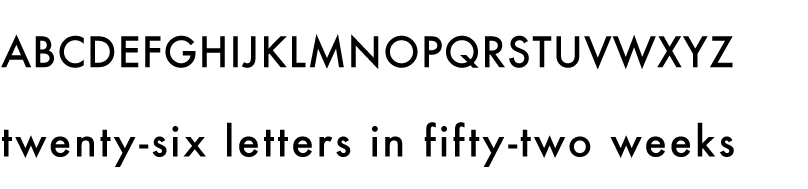
*Point of interest: Futura's famous geometric 'O' (pictured above) is not perfectly round. Adjustments have been made to the stroke weight to add vertical emphasis to the sides.
  • fourteen letter of the Latin alphabet, eleventh consonant
  • phonetic name: "aveolar nasal"; sound: place your tongue against your alveolar ridge, lower your uvula and vocalize through the nasal cavity (n.b.: the pronunciation creates a vibration through the face and head which can be described as reassuring, appeasing, tender and intimate)
  • Egyptian hieroglyphs were flowing water and a snake
  • the name for the letter in the Phoenician, Hebrew, Aramaic and Arabic alphabets is nun (pronounced "noon"), which means "fish" or "water snake"
  • Greeks adopted it as their letter nu (uppercase Ν, lowercase ν), giving us the final letterform we have today (Greeks also gave M and N their rhyming names)
  • in Roman, 'N' once represented 900 (interestingly, M represents 1000)
  • Roman rhetorician Quintilian called N littera tinniens ("the chiming letter"), stating that its sound is "more clear and more frank than other consonants" (n.b.: Lower case 'n' is also reminiscent of a Roman arch or vault)
  • N is a close relative of M, having similar name, sound and shape since the Phoenicians
  • lower case n is a close relative of lower case u; in the 15th and 16th centuries, they could only be differentiated by their context within a word
  • upper case N rotated 90 degrees clockwise becomes upper case Z
  • N with a diacritical tilde (Ñ / ñ) is used in Spanish and Filipino alphabets
  • associated with inferiority, negation and birth
  • N is associated with birth in the prefix "neo-"
  • the earlier version, nun (fish), is said to be a symbolic image from where "it represents the Son of Man, every individual being produced" - a sperm, developing and floating in the womb
  • the Hebrew character represented strong qualities such as purity and power, which were supposed to be concealed for their retainment
  • the connection to water is amplified by the Greek nero and Etruscan neri (both meaning "water")
  • water is also the roots of other words starting with N: navigate, nautical, navy, naval, et al
  • with the exception of the Greek nai ("yes"), N generally expresses the negative (not, none, nothing, nobody, nowhere, never), even in other languages (no, nay, ni, non, nein, nyet, et al.)
  • in abbreviations, "N.B." signifies nota bene ("note well")
  • 'N' on a map, compass or weather map is North
  • "No." or "N°" is number, derived from the Latin numero
  • 'N' is the chemical symbol for nitrogen (#7 on the periodic table), a colourless and odourless gas vital to components of foods, fertilizers, and explosives, and makes up about 78% of the atmosphere by volume but the atmosphere
  • 'N' in physics is newton, a unit of force
  • 'N' in mathematics is an indefinite whole number (ie. "to the 'nth degree")
  • 'N' abbreviates the mathematical prefix nano-, from the Greek nanos, meaning "dwarf"
  • 'N' in printing is a unit of measurement (half the width of 'em' space)
  • 'N' with two horizontal strokes, ₦, is the symbol for the Nigerian naira currency
  • phonetic sound, 'en', can abbreviate "and" (cookies 'n cream, scratch 'n sniff, rock 'n roll)
  • NATO phonetic alphabet: NOVEMBER
  • N-word is a derogatory term meaning or relating to black people
  • "'N' is a gate with a diagonal bar." -Victor Hugo, French poet & playwright
  • "The sound vibration of the consonant 'N' means 'the personal and infinite self." - Joseph E. Rael
  • N can also abbreviate indefinite number, knight, nationalist, navy, neuter, neutral, neutron, nitrogen, nominative, noon, Norse, Norway, note, noun, number

  • thirteenth letter of the Latin alphabet, tenth consonant
  • phonetic name: "voiced bilabial nasal"; sound: place your lips together and use your vocal chords to hum some air through your nose
  • Egyptian hieroglyphs were an owl and a gazelle rib. Interestingly, it was their wavy, zigzag line that symbolized water that was adopted by Semites as MEM (they rotated it 90 degrees.)
  • Greeks restored the original horizonal shape and adopted it as their letter mu (uppercase Μ, lowercase μ)
  • in Roman, 'M' represents 1000 (the highest numeral)
  • associated with aquatic, vibration, humanness
  • there is an aquatic motion inherent to letter M, which is said to connect to "maternal liquidity" and the essence of "being human"; 'M' is found in 61 translations of "mother" (mère, maman, madre, mutter, ma, maa, me, emak, makuahine, mama, emo, ema, ama, et al.)
  • also, "mammal" is any class of animal that suckles (i.e. mammary glands)
  • 'M' is one of the easiest consonants to pronounce, and is often one of the first sounds murmured by a baby (mamamamamama...)
  • the vocalized sound, "em", causes vibration in the brain, acting upon the seventh chakra at the crown of the head (n.b.: 'M' is actually considered a vowel in India)
  • when "em" (or "ohm") is sung on B♭, the sound resonates with the colours violet, white and gold
  • in Chinese koto-dama, "mu" corresponds to birth and maternity, "mo" represents harmony/roundness/the mother, and "mi" is connected with the self
  • in onomatopoeia, "mmmmmmh" expressed pleasure
  • the etymology, in tandem with the primordial sound/sensation, makes "M" symbolize the source of all material and spiritual life - the perfect union of body and soul. (n.b.: "M" is the heart of the alphabet, at position 13 of 26)
  • in French titles, "M." is Monsieur, "MM." is the plural Messiers
  • 'M' can symbolize the Holy Trinity, because of the three triangles in the letterform
  • 'm' in measurement is metre, or mile
  • 'M' in military weapons stands for model (ie. M1, M2, M16, etc.)
  • 'M' in printing is a pica / unit of measurement ('em' space); also, M stands for magenta (CMYK)
  • 'M' in technology is a programming language
  • 'M' in mathematics is million
  • 'm' often stands for masculine or male
  • M in the fictional James Bond empire is the head of M.I.6.
  • M is a nickname for the pop singer Madonna
  • M roof is double peaked roof
  • M is a deep, dreamless sleep, where consciousness is essentially lost
  • M&M's were founded in 1940 by Forrest Mars
  • Vitamin M (aka folic acid), is used to synthesize protein and DNA, and produce red blood cells (in tandem with vitamin B12). Folic acid may help prevent some cancers, as well as reduce chances for birth defects when taken during pregnancy. It can be found in dark green vegetables, organ meats, whole wheat products, legumes and mushrooms.
  • phonetic sound, 'em', can abbreviate "him" or "them" (ie. "Let 'em eat cake!") or Madam (ie. "Yes'm.")
  • NATO phonetic alphabet: MIKE
  • "'M' is a mountain or camp with tents pitched in pairs." -Victor Hugo, French poet & playwright
  • "The sound vibration of the consonant 'M' means 'to bring forth, manifesting, matter." - Joseph E. Rael
  • M can also abbreviate maiden, majesty, male, Malta, Manitoba, mare, mark, married, masculine, master, mature, medieval, medicine, medium, member, meridian, middle, mile, million, molar, Monday, Monsieur, month

  • twelfth letter of the Latin alphabet, ninth consonant
  • phonetic name: "alveolar lateral approximant"; sound: place your tongue on your alveolar ridge and vocalize, allowing air to pass through the sides (n.b.: if you relax your tongue, the sound becomes an 'R'...)
  • Egyptian hieroglyphs were a lion and a mouth
  • adopted by Semites as lamed (a goad, which is a guiding device used to herd cattle, like a shepherd's staff) - as such, it imparted discipline, instruction and education
  • Greeks adopted it as their letter lambda (Λ upper case, λ lower case)
  • Λ was rotated 180 degrees by the Romans in 200 BCE, becoming the L we know today
  • in Roman, 'L' represents 50
  • associated with liquid, square and softness
  • square shape of 'L', with its perfect 90 degree angle, symbolizes rigor, instruction and rectitude
  • lowercase 'l' is generally written as a single vertical line, which can often be confused with uppercase 'I', as well as numeral '1', especially with sans serifs fonts (think about the word 'Ill') - sometimes the lowercase 'l' has an additional spur at the baseline
  • lowercase 'l' was only finalized in ink in the 1400s, making it the last lowercase character to enter the alphabet
  • double 'l' (ll) is a letter in the Spanish alphabet
  • a handful of english words have double ll at the beginning: Lloyd, llama, etc.
  • 'L' can be silent, as in 'should,' 'walk,' etc. Words like 'palm' can be pronounced with or without the 'L'.
  • phonetically, 'L' conveys roundness; calm, soft, light, flux, childishness, slipperiness, departure or gradual release/surrender; 'L' is found in words like liquid, float, flow, fluid, lick, lull, lullaby (n.b.: "cellar door" is considered by some [including J.R.R. Tolkien] to be particularly pleasing to the ear)
  • "It melteth in the sounding, and is therefore called a liquid." - Ben Jonson, English Grammar, 1640
  • 'L' is also associated with divinity, often found in the names of angels (Gabriel, Daniel, Raphael, etc.) - also, 'L' gives "Alleluia" life
  • 'L' in liquid measurement is litre
  • 'lb' in solid measurement is pound, from the latin word libre meaning "scales, balance"
  • £ in currency stands for the British pound sterling
  • 'L' ( or l or ℓ) in mathematics is length (of a line)
  • 'L' in electronics is inductance, similar to inertia
  • 'L' in physics is the Langrarian (kinetic potential), or Luminosity, the measurement of brightness
  • 'L' in mathematics is Gödel's constructible universe
  • 'L' in chemistry is Leucine, an amino acid
  • uppercase 'L' is longitude; lowercase 'l' is latitude
  • 'L' in literature is a novel by Erlend Loe
  • L bar is a steel beam with a L-shaped cross section
  • L block is an L-shaped concrete building block
  • L pipe (aka "ell") is a pipe bent and shaped to a 90 degree angle
  • L square is a L-shaped carpenter's ruler
  • L band is a radio frequency range
  • L can also refer to the left direction
  • in the 20th century, lambda (λ) became a scientific symbol for wavelength (ie. shortwave radio). It became associated with gay pride / gay identity in the 1970s (for reasons of secrecy, discretion - being on the "same wavelength"). Today, lambda is still used in gay-friendly college fraternities and sororities.
  • Vitamin L (aka Anthranilic acid), is used as an intermediate for production of dyes and pigments, used in preparing perfumes to imitate jasmine and orange, used in pharmaceuticals as a UV-absorber, and used as corrosion inhibitors for metals and mold inhibitors in soya sauce.
  • phonetic sound, 'elle', can convey femininity (as in Elle magazine) from the French feminine pronoun 'elle', the masculine singular definite article in Spanish ('el'), or a transliteration of the word 'hell' in the Cockney dialect, commonly pronounced "'ell"
  • Japanese people frequently have trouble pronouncing 'L', often substituting it with the sound of 'R'
  • in 1529, French type designer and calligrapher Geofroy Tory claimed the ancient Romans designed the ideal 'L' based on the shadow cast by a human body shortly after the autumn equinox
  • NATO phonetic alphabet: LIMA
  • "'L' is the leg and the foot." -Victor Hugo, French poet & playwright
  • "The sound of the consonant 'L' means 'ascending light'." - Joseph E. Rael
  • L can also abbreviate constant, lake, large, Latin, law, leaf, league, learner's (license), Liberal, line, link, live, lodge, low, Luxembourg, self-indulgence

  • eleventh letter of the Latin alphabet, eighth consonant
  • phonetic name: "voiceless velar plosive"; sound: place the back of your tongue against your velum and release a pop of air
  • Egyptian hieroglyph was a sandy hill, or a cup / basket with a handle
  • adopted by Semites as the palm of a hand (kaph)
  • Greeks adopted it as their letter kappa (uppercase Κ, lowercase κ or ϰ)
  • in Roman, 'K' represents 250; abandoned by the Romans (because it was barely used) and it was reintroduced in the Middle Ages
  • closely tied to 'C' and 'Q'
  • 'K' can be silent, as in knife, knot, know
  • lower case 'k' is identical to the uppercase 'K', with the exception of the stem which is elongated and becomes an ascender
  • the junction of capital 'K' is usually slightly above letter's geometric centre
  • associated with power, force and Earth
  • as related to the palm of the hand, some words with Greek root 'chiro' are illuminated: chiropractor, chiromancy (palm reading), chirography (study of penmanship)
  • hand palms are considered minor chakras (in addition to the basic seven chakras) - the left palm receives a charge from the surrounding environment, the right palm releases extra electromagnetic charge from the body. Whirling dervishes dance with the left hand point to the Earth, and the right to Heaven.
  • Sumerian word 'kur', meaning "mountain", captures the essence of 'K' - powerful, hard, solid - in both pronunciation and graphic depiction
  • 'K' is also connected with earth / matter - Greek word 'kakos', meaning "bad", gives way to Latin word 'cacare', meaning "to shit"
  • following the smallness of the Greek iota, 'K' gives us grandeur, as in the Greek 'kolossus' (colossus, colossal)
  • "ka" = Egyptian term for vital energy animating gods and men
  • "ki"(also qi/chi) = Chinese term meaning breath or energy
  • 'K' stands for kilo, meaning 1000 (from the Greek word 'khilioi')
  • 'K' represents temperature scale Kelvin named after the Belfast-born physicist and engineer William Thomson, 1st Baron Kelvin (1824–1907). On the Kelvin scale, absolute zero (the theoretical temperature at which entropy would reach its minimum value) is defined as 0 K (−273.15°C Celsius).
  • 'K' is the chemical symbol for potassium (#19 on the periodic table), an essential metallic constituent for plant growth and a vital element in the human diet.
  • 'K' in printing term CMYK stands for black; 'K' was used because 'B' was already in use for blue in RGB
  • in computers, 'K' is the measuring unit for memory
  • 'K' stands for carat the unit measurement for gold and precious metals
  • 'K' is sometimes used in product packaging to represent Kosher
  • in education, K-12 refers to "kindergarten to grade 12"
  • in biology, 'K' is lysine, and amino acid
  • in astronomy, 'K' is a class of stars (between yellow and red)
  • in geology, 'K' stands for the cretaceous period
  • 'K' is slang for the recreational drug ketamine
  • 'K' is a strikeout in baseball
  • in boxing, K.O. is knock-out!
  • K-truss is a building construction truss shaped like letter 'K'
  • K-car is a 1986 Chrysler limousine
  • K-block is a building ward with high security, or for the temporarily insane
  • K-bar is a survival knife in the U.S. Marine Corps
  • K-gun is a battleship weapon
  • K-rations are food provided to soldiers during combat, and generally higher in nutrition than C-rations
  • K2 is the world's second highest mountain, bordering China and Pakistan
  • a police K-9 unit is just a phonetic rendering for canine unit
  • KKK = Ku Klux Klan
  • Romans branded false accusers with the letter 'K'
  • Vitamin K (aka retinol), is a blood clotting agent, and can be found in dark green leafy vegetables, eggs, cheese, pork and live
  • phonetic sound, 'kay', is often used as a substitute for the abbreviation "Okay" or "O.K.". "O.K." is thought to have derived from the notation "orl korrect" (meaning "all correct" or the Greek 'ola kala' (meaning "everything's good" or "all good")
  • 'K' is often used by marketing people in lieu of 'C' to be subversive and "hip". I.e. Kool-Aid, Krispy Kreme, Krazy Kat, etc.
  • the 'K' in Special K stands for Kellogg's
  • NATO phonetic alphabet: KILO
  • "'K' is the angle of reflection equal to the angle of incidence, a key to geometry." -Victor Hugo, French poet & playwright
  • "I find the letter 'K' offensive, almost nauseating." -Franz Kafka, German writer and novelist
  • K can also abbreviate king

  • tenth letter of the Latin alphabet, seventh consonant
  • phonetic name: "voiced post-alveolar affricate"; sound: place your tongue between your alveolar ridge and your top teeth, and make a buzzy sound (n.b: The only two affricate sounds in the English language are 'j' and 'ch')
  • 'j' was the last letter of the alphabet to be added; until the 16th century, 'i' and 'j' were used interchangeably. In France 1542, grammarian Louis Meigret suggesting separating the two sounds into separate letters - 'i' as vowel, 'j' as consonant. Jacques Peletier (1550) and Petrus Ramus (1557) are also credited with supporting this division.
  • 'j' was first used by printers in Holland, and first used in an English-language book published in 1634.
  • 'j' finally achieved full recognition by Noah Webster in 1828, and with his dictionary, delivered the 26-letter alphabet to North America
  • the lower case 'j' began as a swashed version of lower case 'i' to mark differentiation as a consonant
  • upper case 'J' was an invention by 16th century printers. For this reason, it is sometimes criticized as "lacking the balance, boldness, and dignity of the classical Roman letters."
  • 'j' was originally pronounced "jye" (to rhyme with 'i'), but eventually took to rhyming with 'k'
  • 'J' does not appear in the Italian language (excepted imported words)
  • in Spanish, 'j' makes the 'h' sound (as in "Jose"); in German, 'j' makes the 'y' sound (as in "jot")
  • words ending in double i ('ii') were often marked with the digraph 'ij' - the Dutch consider this a single letter, and type designers often create it as a ligature
  • like with 'i', the dot on the lower case 'j' is called a tittle
  • in physics, 'J' is a joule, the energy exerted by the force of one newton acting to move an object through a distance of one metre
  • like 'I', 'J' is associated with verticality, elevation, joy and clarity
  • in astronomy, 'J' stands for Jupiter
  • in economics, 'J curve' illustrates how currency can fall in value
  • "J box" is a J-shapes box through which fabric is passed through for a process such as bleaching
  • "J bag" is a bag used for carrying gold clubs
  • phonetic sound, "jay", is a bird (usually colourful and noisy); "jaywalk" first appeared in print in 1915 (1917?), referring to this intrusive, "simpleton" bird ("jay" in slang can also mean an impertinent person)
  • in colloquial English, 'J' can stand for a joint/cannibus
  • Famous Js / JJs: Jack and Jill, Janet Jackson, J.J. Abrams, Janis Joplin, Judge Judy
  • NATO phonetic alphabet: JULIET
  • "'J' is the plowshare and the horn of plenty." -Victor Hugo, French poet & playwright
  • J can also abbreviate jack, Japan, joule, journal, judge, justice

  • ninth letter of the Latin alphabet, third consonant
  • phonetic name: "near-close near-front unrounded vowel"; sound: smile, press the sides of your tongue against your upper molars and vocalize
  • Egyptian hieroglyph was a pair of reeds, or an arm with a hand
  • arm icon adopted by Semites into a curve with two straight lines to create yodh
  • Hebrew yodh is associated with the Latin tern principum, meaning "beginning, foundation, origin"
  • Greeks adopted it as their letter iota (uppercase Ι, lowercase ι); it was their smallest letter, and has come to mean "a tiny amount"
  • 'J' was a variation of 'I' until the 16th century
  • the dot on the lower case 'i' is sometimes called a tittle; this first appeared in the 11th century when scribes used it to help make the letter more distinct
  • in Turkish, dotted and dotless 'i' are separate letters, in both uppercase (I, İ) and lowercase (ı, i)
  • let's not forget the mnemonic device: "I before E except after C"
  • two common French diacritical marks: accent circumflex (î) or umlaut (ï); umlaut appears in English word "naïve"
  • 'I' can be long diphthong (i.e.: "mine") or short (i.e.: "bill"); this split happened during the Great Vowel Shift in the 15th century
  • 'I' became a personal pronoun around 1150, emerging from the German ich
  • most of Emily Dickinson's poems begin with the person pronoun 'I'
  • according to American Health, the less you use the personal pronoun, the lower your risk of heart disease
  • "'I'...how huge a word in that small English mark, the shape of a Grecian pillar." -William H. Gass, The Tunnel
  • 'I' plays an important role in Roman numerals. I = one unit; I with a dash above it = one thousand units. When placed in front of a Roman numeral, it is subtracted (i.e. V = 5, IV = 4); when placed behind, it is added (ie. VI = 6)
  • 'I' is considered the "incomplete" in education
  • associated with verticality, elevation, joy and clarity
  • as a straight line, it is often deemed a phallic symbol
  • its vertical composition unites heaven and earth, can also represent the spinal chord, uniting the head and feet
  • when sung on the note 'A', the 'i' sound acts upon the sixth chakra - the front chakra - located between the eyebrows and often called the third eye. It is associated with the colour indigo.
  • 'I' is the chemical symbol for iodine (#53 on the periodic table), bluish-black in solid form, and blue-violet as a gas (stinky though)
  • in physics, 'I' can be electrical current, moment of inertia or luminous intensity
  • in mathematics, 'I' is imaginary number equal to the square root of -1
  • in astronomy, 'I' is orbital inclination
  • in economics, 'I' is investment, 'i' is interest rate
  • 'I' placed in a circle means "information"
  • abbreviated, 'I' often means international (IBM = International Business Machines, ISBN = International Standard Book Number)
  • phonetic sound, "aye", means "yes" (especially in voting)
  • NATO phonetic alphabet: INDIA
  • 'I-beam' is a metal construction beam/bar/girder with an I-shaped cross section
  • Apple declared the lower case 'i' to stand dually for "internet" and "individual / individuality" when it released the iMac in 1998
  • "The 'I' evokes brilliance, lyricism, the illusory, becoming, rhythm." -Dictionnaire des symboles
  • like a pillar, 'I' is an essential building block of type design; "Almost all the other letters are formed after this letter, although always something has to be added to it or taken away." - Albrecht Dürer, in 1535 treatise on letter design
  • "'I' is the first letter of the alphabet, the first word of language, the first thought of the mind, the first object of affection." - Ambrose Pierce, Collected Writings
  • "'I' is the war machine launching a projectile." -Victor Hugo, French poet & playwright
  • I can also abbreviate current, incisor, independence, institute, interest, island, isle, Italy


  • eighth letter of the Latin alphabet, sixth consonant
  • phonetic name: "voiceless glottal fricative"; sound: imagine your hands are cold and blow on them to warm them up
  • Egyptian hieroglyphs included a courtyard within a house, a reed hut, a rope made of woven flax, a cow udder/stomach with tail, or a sieve
  • Semitic symbol, heth, stood for a wall, fence, field or enclosure (with two, three or four crossbars)
  • Greeks rotated heth ninety degrees and adopted it as their consonant eta (uppercase Η, lowercase η), but later represented a long vowel (also, Theta: uppercase Θ, lowercase θ or ϑ)
  • in Roman, 'H' represents 200
  • for most of its history, 'H' has held the same position (the eighth letter) in the Semitic, Greek, Etruscan, and Latin alphabets
  • 'H' has an anomalous name, "aitch"; it may have derived from the Old French name "hache" circa 800 A.D.
  • the sound of 'H' (exhaling) involves essentially no pronunciation, and for that reason has had its validity debated by grammarians for centuries; in 1529, French Renaissance scholar rounded out the debate and said this about 'H', "The aspirate is not a letter; nonetheless, it is by poetic license given the place of a letter."
  • 'H' can be silent/faded at the beginning (i.e. hour, honest) or followed by a 'g' (i.e. ghost, ghetto, etc.)
  • many 'H' pairings (i.e. GH, SH, WH, CH) were created in the Middle Ages
  • 'H' nouns get treated like a vowel when spoken (i.e. correct print form is "a historian"; common pronunciation is "an historian")
  • 'H' is common in the friendly salutations "Hi! Hello! Hola! Howdy! How are you?!"
  • associated with stability, construction and columns
  • when Greeks changed composition from horizontal to vertical, the sign no longer represented obstacle but rather elevation; 'H' unites heaven and earth
  • 'H' is similar to 'B' in a couple ways: they both shared same hieroglyph (courtyard), and they have very similar uppercase (H vs. B) and lower case (h vs. b) characters
  • the shape of capital 'H' imparts great stability and groundedness
  • 'H' in chemistry is hydrogen: the first on the periodic table, the lightest element, and the most abundant in the universe (about 90%); also, H-bomb
  • 'H' in physics is henry, the SI unit for electrical inductance
  • 'H', in upper or lower case, can represent 'hour' (i.e. km/h), 'height' (i.e. V = L·W·H) or 'hospital'
  • 'H' can stand for the drug heroin
  • 'H' in Preparation H is hemorrhoid
  • NATO phonetic alphabet: HOTEL
  • 'H-beam' is a metal construction beam with an H-shaped cross section
  • in French, 'H' can mean zero; l'heure 'h' = "zero hour"
  • H can also abbreviate harbour, hard, high, hour, hundred, Hungary, husband

  • seventh letter of the Latin alphabet, fifth consonant
  • phonetic names: 1) "voiced velar plosive" (hard); sound: press the back of your tongue onto your velum and make a short sound using your vocal cords, 2) "voiced postalveolar affricate" (soft); sound: press the middle of your tongue gently against the back of your upper teeth, and make a slight buzzy sound with your vocals cords
  • in Egyptian, four hieroglyphs pronounced similar to 'G': a jar, a handled basket, a hill, and a cobra
  • 'G' is a later-comer to the alphabet; influenced by the sound of Phoenician gimel and Greek gamma, 'G' was created as a variation of 'C' in either 312 BCE by the Romans or 250 BCE to distinguish the consonant's softer pronunciation (which at the time sounded like K). Also, zeta (uppercase Ζ, lowercase ζ)
  • in Roman, 'G' represents 400
  • 'G' can be hard (i.e.: gut) or soft (like 'j' sound) when followed by an e, i or y (i.e.: magic) (Note: 'G' rules are very similar to 'C' rules)
  • 'G' can also be silent when followed by an n (i.e. gnome) or when in words ending in igh, ough (i.e.: sigh, cough)
  • lower case has two variations: a single-story version with a tail curling under (aka opentail), and a two-story version (aka looptail). The opentail derives from a variation of the uppercase (closing the loop and extending the stroke downwards and to the left). The looptail version first looked like a number 3 with a flat top; the upper bar later started to curve down, until the loop eventually closed completely, leaving a circle with an elegant looping tail (which is sometimes open, sometimes closed). Also, the nib on the top right side of looptail version is called an ear.
  • in upper case 'G', the central stem is usually slightly below the letter's geometric centre
  • associated with expansion, germination, and grandeur
  • the spiral shape of upper case 'G' has often been a symbol of life, growth and fruitfulness, as well as movement and revolution, especially counter clockwise (see G, think gyro, Greek for "circular movement")
  • 'G' also has an element of vitality/birth, i.e. 'g' for grain, germinate, genesis; also, Ge and Gaia, Greek terms for Earth
  • also connected to throat, speech and eating, ie. 'g' for guttural (guttur is Latin for "throat"), gargle, regurgitate, gluttony, gourmet, gastronomy
  • also tied to all things grand, ie. 'g' for grandeur, great, grandiose, gargantuan, gigantic (from Greek giga which means "giant" and often stands for 1 billion)
  • 'G' in freemasonry is often found in a five-pointed star, and implies glory, generosity, grandeur, genius, generation, gnosis (Greek for knowledge), gravitation and geometry
  • in physics, 'g' stands for gravity; a G-suit is worn to help withstand G-force
  • in biology, 'g' is guanine
  • in weight, 'g' stands for gram
  • in electronics, 'g' in conductance, the ability of a material to pass electrons
  • 'G' in music in the note 'sol', the fifth note in a C-major musical scale (Sol also means "sun" in Latin)
  • a film rated 'G' is suitable for a general audience
  • NATO phonetic alphabet: GOLF
  • 'G' in 'G-7' stands for group; in this case, the seven biggest industrial nations: Canada, France, Germany, Italy, Japan, Unite Kingdom and USA (for 'G-8', add Russia)
  • 'G' in G-Man stands for government in 1930s gangster movies
  • 'G's' is a colloquial expression for money (i.e. 100 G's = 100 grand, $100,000)
  • 'G-spot' is a female erogenous zone named after German gynecologist Ernst Gräfenberg
  • 'G-string' is a type of skimpy underwear (similar to a thong) worn by strippers or dancers, and may have originated from the term geestring, which held the loincloth of Native Americans. 'G' may stand for girdle, genital or groin.
  • G can also abbreviate gallon, German, good, government, gram, gulf
  • phonetic sound, "gee", is an example of a minced oath: an expression based on a profanity that has been altered or abbreviated to reduce the objectionable characteristics of the original expression; in this case, "gee" or "Jeez" is shortened, tamer version of "Jesus!"